For Fox Sake · https://forfoxsake.news/history/leicester-city-at-the-world-cup-61412
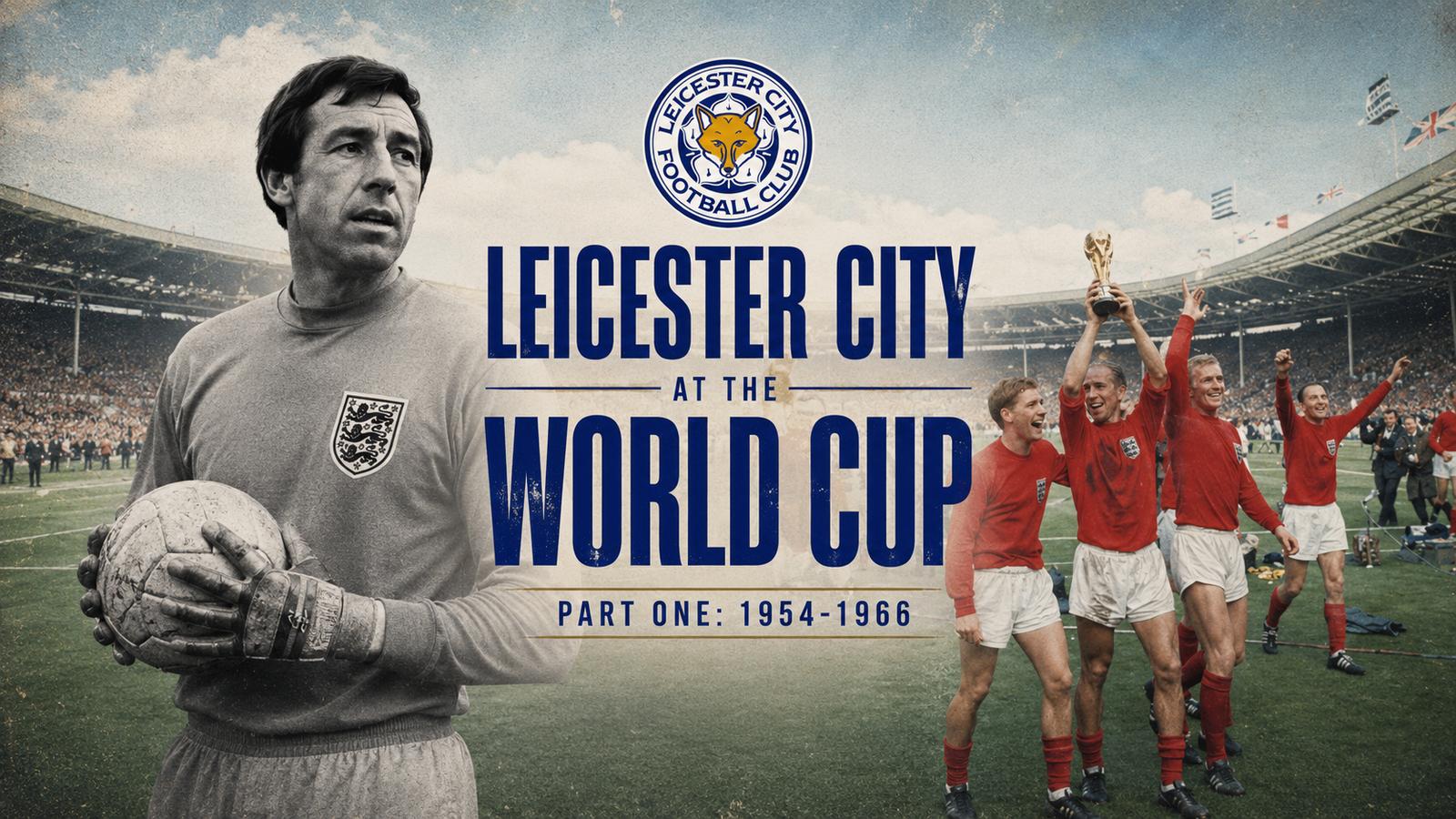

Leicester City at the World Cup: Part One 1954-1966.
08.06.26, 00:00 Updated 28.08.26, 10:53 10 Minute Read
Throughout the entire history of Leicester City Football Club, any current player who plays at the World Cup Finals has provided the Blue Army with great pride.
For many years, it simply never happened. Little old Leicester having a player on the greatest stage of all?! But times change. With the influx of foreign players in the 1990s, alongside the last decade of unparalleled success, it has been the norm for a multitude of familiar players to grace our screens during the summer months, every four years.
With the 2026 FIFA World Cup starting this week, let's take a look back at those players who represented their country at the World Cup Finals whilst at Leicester City.
This series will be split into four parts: 1954-1966, 1982-2002, 2014-2018, 2022-2026
Let's start with the World Cups of 1954-1966. This includes the first City player to play at the World Cup, and our only World Cup winner.
“We're starting with a player who doesn't actually qualify for the list, but the great City goalkeeper John Anderson and the 1954 FIFA World Cup deserves a mention.”Pete Selby - For Fox Sake
Switzerland 1954
John Anderson - Scotland #87 Top 100 Leicester City Players
We're starting with a player who actually doesn't qualify for the list, but City great John Anderson deserves a mention.
Anderson’s Leicester City career spanned three decades, including National Service with the RAMC. He twice won the Second Division championship with Leicester City in the 1950s. For more on Anderson, see his inclusion in our Top 100 players of all time through the link next to his name.
He won his only cap for Scotland in their final preparation match for the 1954 FIFA World Cup against Finland.
John Anderson was named in Scotland's 1954 finals squad as understudy to Fred Martin. But Anderson did not travel to Switzerland as Scotland chose only to take 13 players. Anderson stayed at home on reserve, along with the likes of Bobby Combe and Jimmy Binning.
In the 1954 FIFA World Cup Finals in Switzerland, Scotland lost both of their group stage matches; they were defeated 1-0 by Austria and swept aside 7-0 by defending champions Uruguay.
“It was the most important goal of my career, it was the only goal against a strong Wales team. And for me personally, it was the start of everything!”Pele - on scoring against Wales, aged only 17, in the 1958 World Cup Quarter Finals.
Sweden 1958
Cunningham was a superb right-back who played for Leicester City between 1954 and 1960.
He was instrumental in winning the Second Division title under manager Dave Halliday in 1957. Cunningham was a regular as City stabilised in the top flight with consistent mid-table finishes over the following three seasons under Matt Gillies. At the time, the 23 international caps he won whilst at Filbert Street made him the most capped player in the club’s history.
In 1958, he became the first player under contract at Leicester City to appear at a FIFA World Cup Finals.
Cunningham was ever-present during the Northern Irish side's great run at the 1958 FIFA World Cup in Sweden.
They out-performed Home Nation rivals England and Scotland to reach the quarter-finals, winning many friends and plaudits with their entertaining, attacking football, encouraged by manager Peter Doherty, and skipper Danny Blanchflower.
Willie played in all three group matches against West Germany, Czechoslovakia and Argentina, and also in the play-off against Czechoslovakia and in the quarter-final, where Northern Ireland were defeated by eventual finalists France.
Captain Danny Blanchflower's younger brother Jackie, was Northern Ireland's regular centre-half. His career was sadly ended by the Munich air crash in February 1958. Manager Peter Doherty, realising there was no ready-made replacement, switched Willie Cunningham to centre-half where he played for the entire tournament.
The defining story of Ken Leek's Leicester City career and Wales's 1958 World Cup campaign, centres around games he never actually played in!
In 1961 Ken Leek was superb as City progressed all the way to the FA Cup final. He scored in every single round. But in one of the biggest shocks in City's history, Ken Leek was sensationally dropped for the final by manager Matt Gillies.
In 1958, uncapped Ken Leek was selected as part of Wales's World Cup Squad. He never made an appearance in the finals.
Wales progressed through the group stages with draws against Mexico, Hungary and hosts Sweden. A play-off victory over Hungary sealed Wales's progression.
Their tournament ended with a historically brave 1-0 defeat to eventual winners Brazil in the quarter-finals, 17-year-old superstar Pele with the only goal.
PELÉ - against wales 1958

It would be two further years before Ken Leek was to win the first of his 13 caps for Wales.
“Every day, I can think back to 1966 if I want and remember things from every single day of that tournament. Not just the final, every day of the tournament. It was wonderful.”Gordon Banks
England 1966
Gordon Banks - England
Gordon Banks is the most famous of all Leicester City players to have played in the FIFA World Cup Finals. He is the one Fox who has lifted the greatest prize in professional football.
Banks was into his seventh year with Leicester City when England hosted the FIFA World Cup in 1966. When he joined the club, he replaced Johnny Anderson (see the above 1954 World Cup) as City's first choice keeper. He was a central figure to Matt Gillies's excellent side of the 60s.
He was twice an FA Cup finalist in 1961 and 1963, a League Cup winner in 1964 and runner-up in 1965. City enjoyed mid-table to top-half finishes, with Banks providing the defensive solidity Gillies wanted. His cat-like reflexes, superb positioning and unmatched agility made Banks the undisputed England number one.
"Every time we played here the nerves were enormous," Banks told the FA. "From the moment you got on the coach to come to the ground to walking up the tunnel, hearing the roar and then singing the national anthem. You wanted to get on with the game because when that whistle blew, all that tension just went. Then you just had to concentrate on what you were doing and you knew that."
After the 1962 FIFA World Cup in Chile, the Football Association appointed Alf Ramsey as England manger. He instantly looked to build a squad to win the forthcoming home 1966 FIFA World Cup.
Ramsey gave Gordon Banks his first England cap on 6th April 1963, against Scotland at Wembley. Banks never looked back.
He entered the 1966 FIFA World Cup as England's first-choice goalkeeper. His understudies Ron Springett and Peter Bonetti never played a minute during the tournament.
England opened their home World Cup with a goalless draw against Uruguay. Banks hardly touching the ball as the Uruguayans concentrated on keeping a clean sheet rather than attacking.
England beat Mexico 2–0 with Gordon Banks again rarely called upon in a straight forward win. A 2–0 win over France followed which took England through the group stages without Banks conceding a goal.
Gordon Banks recalls his memories of winning the

In the last eight England faced Argentina. In a bad-tempered game, England won 1–0 with Geoff Hurst scoring a header. Argentinian midfielder Antonio Rattín was sent off in the first half and Ramsey pulled his players away from the opposition at the end so they wouldn't shake hands.
The semi-final was against Eusébio's Portugal. Gordon Banks had his first major issue of the tournament and it wasn't his fault.
England trainer Harold Shepherdson forgot to buy chewing gum, which Banks used to make his hands sticky. So Shepherdson had to run to a nearby newsagent's to purchase gum as the teams were in the tunnel!
It was a superb match between two great sides. Bobby Charlton scored twice but Portugal replied late on with a penalty. In the 82nd minute, Jack Charlton handled the ball in the penalty area and Eusébio sent Banks the wrong way. England held on and were in the final.
Eusébio's penalty was the first goal Banks had conceded for England in 721 minutes of regular play. A record which remained until 2021 when it was broken by Jordan Pickford.
30th July 1966, the World Cup Final. England vs West Germany.
England v West Germany: 1966 World Cup Final |

England dominated but it was Germany who scored first. Ray Wilson's weak header gave Helmut Haller the chance and he scored past Banks into the corner. England equalised through a Geoff Hurst header only six minutes later and led late in the second half through Martin Peters's goal.
With only seconds left, and the whole of England ready to celebrate, Lothar Emmerich sent a free-kick into the England penalty area. It fell to Wolfgang Weber whose shot went over the lunging Ray Wilson and an outstretched Banks into the net. The game went into extra-time.
Early in extra-time, Banks was called upon on a number of occasions. His handling was exceptionally calm.
Geoff Hurst went on to to score again with the hotly disputed 'was it over the line?' goal. Of course it crossed the line. Gordon Banks once again stood firm to save a powerful shot from Sigfried Held before Hurst ran through late on to score his hat-trick goal, and England's fourth.
England and Leicester City's Gordon Banks were World Champions.
In recognition of his efforts, Gordon Banks received a civic reception in Leicester on 12th August 1966.
Tomorrow - Leicester City at the World Cup: Part Two 1982-2002. The 80s Irishmen to Muzzy's Turkish Adventure



Pete Selby Football Commentator